

The housing slowdown is testing affordability. For investors, the longer-term question is where future housing needs will translate into demand for developable land.
U.S. housing headlines capture a market under pressure. Higher borrowing costs are delaying purchases and challenging builders. Yet sales activity alone is an incomplete guide to the sector’s investment prospects. Financing conditions can change faster than the household formation and replacement needs that shape housing demand over a decade.
For investors, the challenge is to assess how today’s constraints affect the timing, location and economics of tomorrow’s housing supply.
Affordability Shapes the Pace of the Market
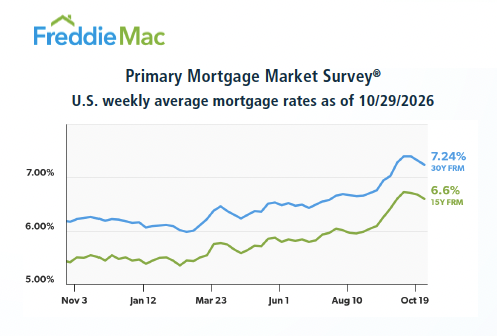
Freddie Mac reported an average 30-year fixed mortgage rate of 7.24% on October 29, 2026, compared with 6.17% a year earlier.1 For an illustrative $300,000 mortgage over 30 years, that increases monthly principal and interest from approximately $1,832 to $2,044. Taxes, insurance and other costs are additional.
September new single-family home sales were estimated at a seasonally adjusted annual rate of 676,000, while total housing starts stood at 1.221 million. Both were below their year-earlier estimates.2,3 They warrant attention without defining the entire investment outlook.
Long-Term Need Remains an Investment Consideration
In September 2026, John Burns Research and Consulting estimated demographic-based housing demand at approximately 1.3 million homes annually over the next decade.
Its assessment includes new households, replacement of homes lost to obsolescence or damage, and additional second homes.4
The research also anticipates slower household formation than in the first half of the 2020s.4 Immigration, population growth and affordability remain variables. Continuing housing need provides a foundation for assessing future development, while investment decisions must account for how quickly that need becomes financially viable demand.
National Figures Require a Local Investment Lens
Freddie Mac estimated a national housing shortage of 3.7 million units using data through the third quarter of 2024. Its methodology considers households that might have formed under more affordable conditions and vacancies needed for a functioning market.5 This is historical context, rather than a current shortage count.
Meanwhile, the Census Bureau estimated 8.4 months of new-home supply in September 2026 at the current sales pace.2 Long-term national need can coexist with unsold homes in particular markets. The availability of housing says little about whether it matches the location, price and product buyers require.
For investors, that distinction places local employment, household growth, competing supply and ownership costs at the centre of market selection.
Recent employment and population trends illustrate these local differences. Among large metros, nonfarm employment increased in only 6 of 56 over the past year; Dallas-Fort Worth and Charlotte were among them. Houston and Dallas-Fort Worth led metro population gains, followed by Atlanta, Phoenix and Charlotte.6

Builder Responses Reveal the Pressure on Project Economics
The National Association of Home Builders reported that 65% of builders used sales incentives in October 2026, while 43% reduced prices.7 Mortgage assistance can help buyers manage monthly payments, but incentives also cost builders money and can pressure margins.
Adjustments to floor plans, construction schedules and land commitments are therefore relevant investment signals. They show how builders are responding to affordability constraints. Demand for housing only supports a viable project when delivery costs and achievable selling prices align.
Land demand follows the ability to deliver housing
Additional homes require suitable land, through new development or redevelopment. The investment relevance lies in land that can serve identifiable housing needs: close to employment, supported by infrastructure and capable of securing the necessary approvals. Land readiness and acquisition cost influence whether builders can deliver homes at prices buyers can afford.
Near-term land purchases may slow as builders protect cash flow and manage inventory. Over a longer horizon, household growth and commercially viable projects will shape demand. Investors should assess housing need, development readiness, builder demand and holding period together. The continuing need for homes supports the relevance of developable land; disciplined selection determines which locations and projects merit capital.
Sources
1 Freddie Mac — Primary Mortgage Market Survey, October 29, 2026. Average 30-year fixed rate 7.24%; year-earlier comparison 6.17%. https://www.freddiemac.com/pmms
2 U.S. Census Bureau and HUD — New Residential Sales, September 2026, released October 27, 2026. New single-family sales 676,000 SAAR; months’ supply 8.4. https://www.census.gov/construction/nrs/current/index.html
3 U.S. Census Bureau and HUD — New Residential Construction, September 2026, released October 20, 2026. Total housing starts 1.221 million SAAR. https://www.census.gov/construction/nrc/current/
4 John Burns Research and Consulting — Recalibrating Housing Demand: Why the Old Assumptions No Longer Hold, podcast episode 124, September 3, 2026. Transcript discussion of demographic demand, replacement needs and slower household formation. https://jbrec.com/podcasts/episode-124/
5 Freddie Mac — Housing Supply: Still Undersupplied by Millions of Units, November 26, 2024. Estimated shortage of 3.7 million units using Q3 2024 data; methodology includes latent households and target vacancy. https://www.freddiemac.com/research/insight/housing-supply-still-undersupplied
6 U.S Bureau of Labor Statistics — TED: The Economics Daily, released November 3, 2026; https://www.bls.gov/opub/ted/2026/employment-up-in-6-large-metropolitan-areas- down-in-1-over-year-ended-september-2026.htm
7 National Association of Home Builders — Builder Sentiment Falls on Rising Rates, October 2026. Builder survey: 65% using incentives; 43% cutting prices. https://www.nahb.org/news-and-economics/press-releases/2026/10/builder-sentiment-falls-on-rising-rates
Disclaimer
The information contained in this document is provided for informational and reference purposes only and should not be construed as investment, financial, legal, or tax advice. While every effort has been made to ensure the accuracy of the content, no representation or warranty is given as to its completeness or reliability. Readers should conduct their own research or consult a qualified professional before making any investment or business decisions. Walton Global accepts no liability for any loss arising from the use of this information. Walton and its representatives are not licensed to deal with any property located in Mainland China, Hong Kong, Macau, Taiwan, Japan, Korea, UAE, Singapore, Malaysia, Thailand, Vietnam, India and Indonesia.